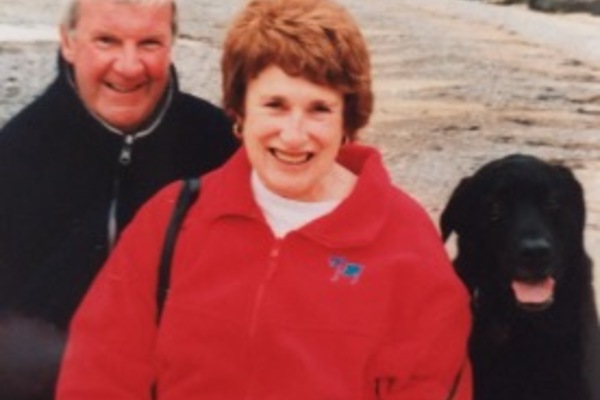
Threading through life are many strands, and Marfan syndrome is only one part of the journey. Mike has shared his eventful life story of diagnosis and MFS, love and loss, friendship and frightening words, surgery and the importance of a support network. Read Mike’s full and fascinating account:
MY MARFAN JOURNEY by Mike Scott
There can be another tomorrow
A personal journey through family, diagnosis, treatment, loss, resilience and hope.
I was born in the Ayr on the west coast of Scotland, the eldest of four children. I had two sisters and a brother, although sadly we lost my brother when he was just five because of a liver condition.
Like many young people, I went through school and into my teenage years looking ahead. At 15, I started my first job with a national DIY chain. I worked hard, progressed into management and, at 19, moved to London as my career gathered pace.
Then, in March 1972, my father died. His death was recorded as coronary arterial disease. I returned to Scotland to support my mother and family, feeling very much like the man of the house. After two weeks I returned to London, keeping in touch with my mother and sister and visiting whenever I could, while continuing to build my career.
Then I met someone who changed my life. After a few years, she became my loving wife, Diane. We shared a love of the outdoors and spent years walking the hills and glens of the Highlands and Islands of Scotland, as well as the Lake District and Yorkshire Dales, often with our dogs. We moved from a flat into a bungalow and continued with our lives.
Little did we know that our journey was about to change.
My younger sister, aged 34, was rushed to hospital with what was thought to be a heart attack. She was transferred to another hospital in Glasgow, where doctors discovered that she had a ruptured aorta and went straight to theatre.
When I arrived the following day, she was being taken back into theatre because of complications. It was during those frightening hours that I first heard the words Marfan syndrome, a genetic disorder I had never heard of before.
Thankfully, my sister grew stronger each day. In time, she returned to work at a local shoe shop, eventually working alongside her daughter on Saturdays.
From the outside, life seemed to be returning to normal. But for us, nothing was quite the same. We now had a name for what had happened, and many questions.
Finding answers and hope
After returning to London, Diane and I began looking for answers. We found the Marfan Association and an incredible person, the late Diane Rust. We also learned about Dr Anne Child, who both worked relentlessly to raise awareness of Marfan syndrome and bring the condition to the heart of the medical profession.
What struck me was that this was about much more than a diagnosis. Scientists, doctors, consultants, students and researchers were being brought together, while money was being raised for projects aimed at improving the lives of people living with Marfan syndrome.
I attended open days at St George's, met people in similar situations to me and listened to scientists, doctors and researchers telling their stories, explaining what they were working on.
For the first time, I could see that Marfan was not simply something that had happened to my family. People were working to understand it, improve treatment and change the future.
I looked at what mattered most to me: my wife Diane, my family in Scotland, and the support and inspiration I found through the Marfan Association and community.
It was at this point that I began to believe there could be another tomorrow.
Now it was my journey
After a couple of years of tests and investigations, I was placed under the care of Professor Yacoub and his team in 1996, at Harefield Hospital.
In 1999, I had my first operation to repair my aorta when it had reached 5.5cm. My own valve was retained.
Six months later, I returned to my management job and continued with my life.
That was an important lesson for me. An operation was not the end of my working life or the end of my plans. It was part of the journey.
But the journey wasn't over. Towards the end of 2000, I began to feel unwell and met the surgical team again. A tiny leak had developed from my own valve.
In 2001, I underwent a second operation, this time receiving a mechanical valve. There were complications and my hospital stay was longer. It took ten months before I was able to return to my career.
The hardest loss
During this same period, our family experienced the most devastating loss of all.
In 2000, my niece, aged 20, also needed surgery because her aorta was growing rapidly. She was a bright young woman who had done well at school. She played hockey and netball, represented her county and had been selected for Scotland trials.
Her operation initially appeared to be successful. For around 36 hours, we hoped that everything was going to be alright.
Then a complication occurred. She was placed on an ECMO machine to give her heart time to rest. After what seemed like a lifetime, we learned that a clot had travelled to her brain. Eventually, the decision was made to switch off the machine.
I never believed that my niece would die from her operation. Her death changed me.
It also made me think deeply about the uncertainty that exists in all our lives. We take risks every day, often without thinking about them. Even walking out of the front door means accepting a degree of uncertainty.
My sister never had a choice about her emergency, while my niece and I had choices to make about treatment. We made those choices and accepted the risks.
That does not make the loss any easier, but it has helped me understand something about living with Marfan: we cannot allow fear to take away the life that is still there.
My sister sadly died in 2009, aged 51.
Life after the storms
There were more difficult years to come. My wife Diane, who stood by my side through every step of my journey, sadly passed away in January 2024. We had been together for over 50 years and married for 48 of them. My life was shattered, and for the first time I found it difficult to see how I could move forward without her.
For the first time in my life, I could not find a way forward on my own, so I sought help from a bereavement therapist.
I found a remarkable lady who not only helped me through my grief, but also knew as much about Marfan syndrome as I did. Over time, she has helped me to cope with and adjust to a different way of life without Diane, while helping me understand that, in many ways, Diane is still by my side, just in a different way. I still see my bereavement therapist from time to time, and I know she will continue to support me and be part of my journey going forward.
Sometimes I look back on those difficult years and wonder how I managed to keep going. I believe the strength and determination came from the people around me who cared - Diane, my family and friends in Scotland, and the Marfan Association and its community, who were there for me throughout my journey.
And then there is my younger sister, Margaret, who lives in the village of Mossblown on the west coast of Scotland where we grew up. She comes to see me regularly, and we speak on the phone every week. We have shared so much of this journey together, and having her close in my life is a reminder that, even though the hardest times, family remains.
Life changes, sometimes in ways we never expect. But somehow, we find the strength to keep moving forward.
And my life continues
I have learned that moving forward does not always mean doing something extraordinary. Sometimes, it simply means accepting a helping hand.
Today, I still live independently in the home Diane and I shared for many years. I use a crutch and still drive, although I do keep a Zimmer frame in my car for longer walks.
I take care of my personal needs and cook my own meals. I have regular visits from a small group of people who help me with some of the essential, everyday things. Their support allows me to continue attending appointments, meeting friends for lunch or coffee, and enjoying life on my own terms.
And there is still plenty to keep me occupied. I enjoy reading, particularly history, science and astronomy, and I am still trying to get my head around technology - and I mean trying!
Now aged 75, I have a few additional age-related ailments that mean I am a little slower than I once was. But I have learned to adapt, to accept help when I need it, and to appreciate the people around me.
The people who support me go above and beyond what is required of them. Along the way, they have become much more than helpers — they have become true friends.
What I have learned
Looking back over the years, I have seen how far the understanding and treatment of Marfan syndrome have come.
When I first heard those words in a hospital, there was so much I did not know. Today, research, specialist care, patient information and advances in aortic surgery are continuing to change what is possible for people living with Marfan syndrome.
But medical progress is only one part of the story. I have learned about the importance of asking questions, seeking information, building a support network and adapting when life doesn't go according to plan.
Most of all, I have learned that a diagnosis does not have to become the definition of who you are.
Another tomorrow
Some of you reading this will recognise parts of your own journey. Others may be hearing about Marfan syndrome for the first time, or may only just be beginning to understand what it means for you or your family.
If that is you, I hope my story gives you something. Hope, perhaps. Reassurance, perhaps. Or simply the knowledge that life can continue after the frightening words, the operations and the uncertainty.
The Marfan community has come a very long way since I first heard the name. I will always be grateful to the late Diane Rust, Dr Anne Child, the researchers, clinicians, volunteers and everyone who has worked — and continues to work through the Marfan Trust and beyond — to give people like us a better future.
When I look back, I don't only see the operations, the losses and the difficult days. I see a life filled with love, family, friendship, work, walking, laughter and memories.
Marfan syndrome has been a significant part of my journey. But it has never been the whole journey.
My life continues to move forward.
And after everything I have experienced, I still believe there can be another tomorrow.
“Together we can!”
These three words from the late Diane Rust, founder of the Marfan’s Association have stayed with through my journey.