Appearances Can Be Deceptive
Marfan Misconceptions

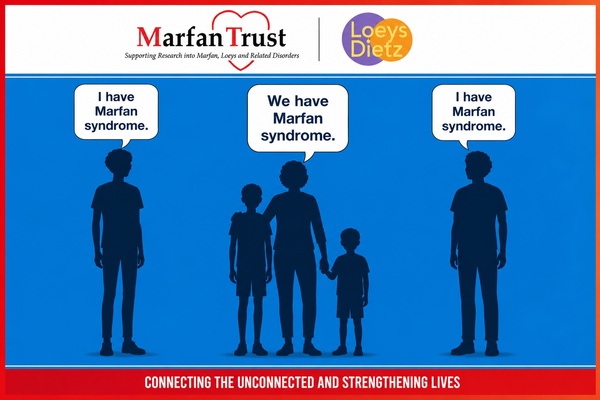
In raising awareness, we alert people to the height and slender frame associated with Marfan and Loeys-Dietz syndromes. People often respond, somewhat crossly, to remind us that not everyone with these conditions is tall and thin. Rightly so! We therefore recently asked our community how tall they and their Marfan family members are, expecting perhaps a familiar pattern of height and slenderness, with a few outliers. What emerged instead was a fantastically unruly collection of measurements, shapes and stories!
Our Informal "Survey" Revealed...
There are the very tall: 6ft 9, 7ft, even over 7ft. One person is 6ft 4, while their mother, who also had Marfan syndrome, was just 5ft 4. Another is 6ft 2; their brother was 7ft and had the more recognisable “classic” body shape. One family ranges from 6ft to 6ft 9, while another describes itself as “a very small Marfan family”: a mother at 1.60m, daughter at 1.72m and son at 1.80m.
And then there are the decidedly less tall.
One woman is 4ft 9. Another is 5ft 2. Someone else is 5ft 4 and describes herself as “huge”. A number of women are between 5ft 5 and 5ft 7. One was once 5ft 5 but has lost four inches through osteoporosis and scoliosis. Another was 5ft 8½ but is now 5ft 7. “Grateful to be the shortest one in the family!” she says.
Height, it seems, tells us surprisingly little.
One contributor is 5ft 9 and says she “does not fit the Marfan look”. She was overweight for much of her adult life and underwent gastric sleeve surgery, yet suffered a Type A aortic dissection this year.
Another, diagnosed at 49 after emergency surgery for a Type A dissection, is 5ft 11. Even now, people are surprised that her husband has Marfan syndrome because he doesn't look “typical”.
For some, being outside the expected physical profile has meant being overlooked. “I was told my son didn't have Marfan due to not being tall,” writes one mother. He is now 5ft 8 and towers over his parents. Height is relative!
Another remembers a doctor looking at her and, after hearing her family history, saying: “Well obviously you don't have Marfan Syndrome, right?” She was 5ft 5 and, at the time, considered morbidly obese. Her sister has Marfan syndrome and is 5ft 9¼; their mother was 5ft 7.
One contributor was grateful for her family history of Marfan, remarking "lots of clinicians have commented that I don’t look typically Marfan and had it not already been diagnosed in my family, I suspect the dissection I experienced would’ve ended in quite a different way."
Perhaps most striking are those whose diagnosis came only when another clue finally prompted someone to look beyond appearances. One woman, 6ft 4, says that an eye doctor noticed similarities between her and her mother and recommended a cardiologist. Genetic testing eventually confirmed Marfan syndrome.
Another contributor points out that people can change physically over a lifetime. Some were given growth hormone when young and no longer have the body shape they had in adolescence. Others have become heavier with age. Others have lost height through scoliosis or osteoporosis.
“Doctors need to be curious, not make assumptions,” one contributor writes.
Marfan syndrome is a connective-tissue disorder, not a body shape. Some people are exceptionally tall and slender; others aren't. Some have long fingers, crowded teeth, scoliosis or an indented chest; others may have few outward clues at all. And within the same family, the differences can be remarkable: “We are a collection of different symptoms and are all different,” as one contributor puts it.
The familiar “Marfan look” may be a useful clue. But it should never become a rule.