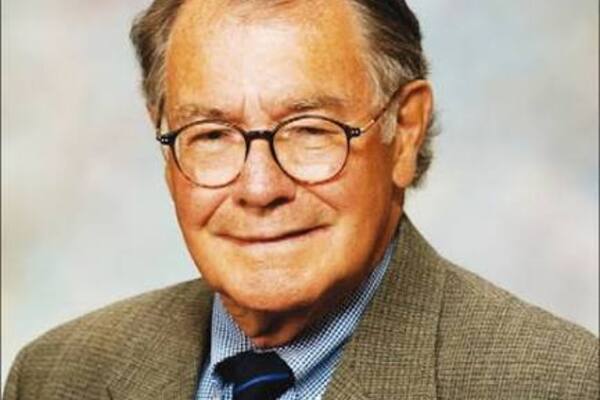
Professor Rodney Grahame
A tribute

Rodney Grahame (1932 - 2026) was an early champion of patients with rheumatological and joint hypomobility syndrome (JHS – painful loose joints). While I was training in genetics as a staff member in Professor Polani’s clinical genetics unit at Guy’s Hospital, studying Marfan syndrome, Rodney sent me a series of JHS patients, asking “do they have Marfan syndrome?”. In taking their family histories, it was clear that the pattern of inheritance was autosomal dominant but the sexes suffered differently. Women were affected with generalised joint hypermobility, their affected male relatives suffered back and knee pain predominantly, worsening in middle age. Echocardiograms for both sexes revealed normal aortic root diameters, ruling out Marfan syndrome, together with the lack of eye involvement. However, frequently mitral valve prolapse (MVP) was discovered in females. This suggested a generalised connective tissue disorder.
Together with other expert colleagues, Rodney published his first book on Joint Hypermobility, and spent his life learning and teaching early diagnosis and correct management of the hypermobility syndromes to three generations of doctors, nurses, physiotherapists and patients, always with great enthusiasm, courtesy and empathy.
He saw the discovery of the genetic differentiation of the various types of Ehlers-Danlos syndrome, as well as Marfan syndrome. However, the commonest mildest form of dominantly inherited JHS (hEDS) still remains a mystery to be explored.
Certainly, families are available for genomic study however if funding could be found in Professor Graham’s memory, it would continue his interest and curiosity in solving a common cause of the illness which captivated his interest throughout his lifetime.
In our Sonalee Laboratory at Queen Mary’s University of London, we have large family studies underway of hEDS, with samples ready for DNA analysis, and candidate genes already identified. However we need PhD student funding for three years to refine our new candidate loci in these large UK families.
Any interested donors could please contact me personally, at the email or telephone number below.
We are still looking, Rodney, with a curiosity inspired by your special genius. I am certain that publications will ensue, and round out the Joint Hypermobility Syndrome picture.
Rest in peace.
With much gratitude from all of us,
Anne Child
Dr Anne Child MD FRCP,
Chair and Medical Director, Marfan Trust
Honorary Research Associate Imperial College
[email protected]
0333 0133 5356