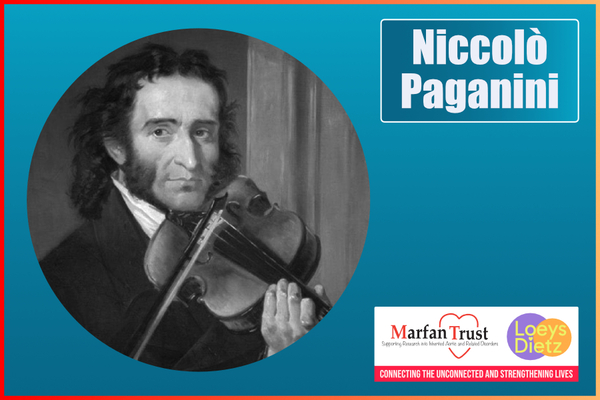
Dubbed “the witch’s brat” for his preternatural virtuosity on the violin, Niccolò Paganini was the original showman.Thought by historians and physicians to have had Marfan or Ehlers–Danlos syndrome, he possessed long, hyper-extensible fingers whose uncanny reach gave him extraordinary freedom across the violin fingerboard, revolutionising the instrument’s technical possibilities and leaving audiences breathless.
Niccolo Paganini (1782 - 1840) was an Italian violinist and composer, and one of the most celebrated virtuosos of his time. He cut a striking figure with his pale face and razor-thin frame - heightened by his all-black ensemble - as he played three octaves across four strings in one handspan ... prompting the rumour that he was in league with the devil!
Born in Genoa in 1782, Paganini displayed an extraordinary musical aptitude from early childhood. Taught first by his father, a struggling merchant and part-time musician, he graduated from the mandolin to the violin with such astonishing speed that his local instructors were soon unable to challenge him.
Determined to cultivate his son’s talent, Paganini’s father brought him to Parma to study under the renowned violinist Alessandro Rolla. Legend has it that Rolla, impressed by the boy’s formidable technique, redirected him instead to the composer Ferdinando Paer and Paer’s mentor, Gasparo Ghiretti.
In 1801 Paganini moved to Lucca, where he was later appointed court violinist to Elisa Baciocchi, Napoleon Bonaparte's sister. After leaving the court, he toured Italy performing his own compositions before embarking in 1828 on a triumphant European tour that carried him from Vienna to Paris and cemented his reputation as the greatest violin virtuoso of his age.
Paganini’s performances inspired scenes of near hysteria, and his uncanny technique gave rise to rumours that he had made a pact with the devil. Though he amassed considerable wealth, his compulsive gambling, serial womanising, extravagant lifestyle and declining health overshadowed his later years. After his death in 1840 at the age of 57, the Church - citing his refusal of last rites - denied him a Catholic burial for decades.
Legacy
Niccolò Paganini is remembered as one of the greatest violinists of all time. He was one of the first solo violinists to perform without sheet music, choosing instead to memorise everything. He also expanded the instrument’s possibilities through composition, most famously in his 24 Caprices for Solo Violin, works renowned for their extraordinary technical demands.
Many believe that Paganini's "creativity may have been influenced by his biochemical makeup ... which may have resulted from an hereditary disease of connective tissue - either Ehlers-Danlos or Marfan's syndrome".
Indeed, in 1831, Paganini's personal physician wrote, “Paganini’s hand is not larger than normal; but because all its parts are so stretchable, it can double its reach. For example, without changing the position of the hand, he is able to bend the first joints of the left fingers –which touch the strings–sideways, at a right angle to the natural motion of the joint, and he can do it with effortless ease, assurance, and speed. Essentially, Paganini’s art is based on physical endowment, increased and developed by ceaseless practising.”