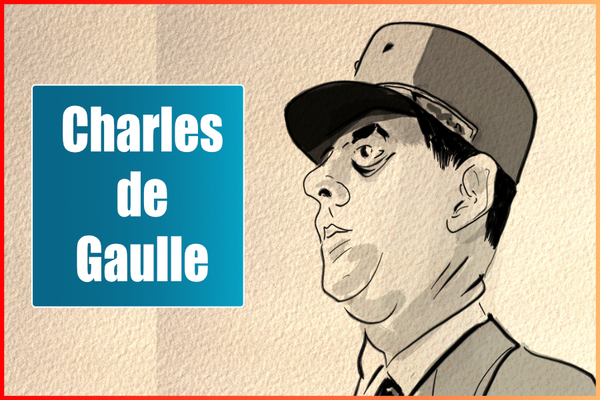
A tall, forceful man, Charles de Gaulle left a lasting political legacy. It was a little-known fact that this heroic figure, former President of France and once described as the "embodiment of France", had Marfan syndrome. Tenacious leader of the Free French Forces during World War Two, he cuts a singular figure in the black-and-white wartime footage. Whether inspecting the French Navy or walking alongside Britain's Prime Minister, Winston Churchill, he stands out, literally. His condition remained a family secret until only recently.
As a relatively junior general in 1940, Charles de Gaulle (1890–1970) demonstrated extraordinary resolve by refusing to accept France's surrender to Germany in the Second World War. Escaping to London after the French government, led by Marshal Philippe Pétain, sought an armistice following the fall of France, he made his famous Appel du 18 juin broadcast on the BBC, urging the French people to continue the fight against Nazi Germany. Throughout the war, he became the uncompromising voice of Free France. Although commanding a much smaller and weaker military force than his Allies, he never hesitated to challenge Winston Churchill and Franklin D. Roosevelt, famously remarking, "I am too poor to bow."
Returning to power during the Algerian crisis in 1958, de Gaulle drove through a new constitution establishing the Fifth Republic. It transformed the French presidency into one of the most powerful executive offices in the democratic world, a legacy that continues to shape France today. He was also the tallest man ever to serve as President of France.
Charles de Gaulle kept his Marfan syndrome a closely guarded family secret. Standing 6 feet 5 inches tall, he died at the age of 79 from a ruptured aneurysm. His successor, President Georges Pompidou, declared: "General de Gaulle is dead. France is a widow."