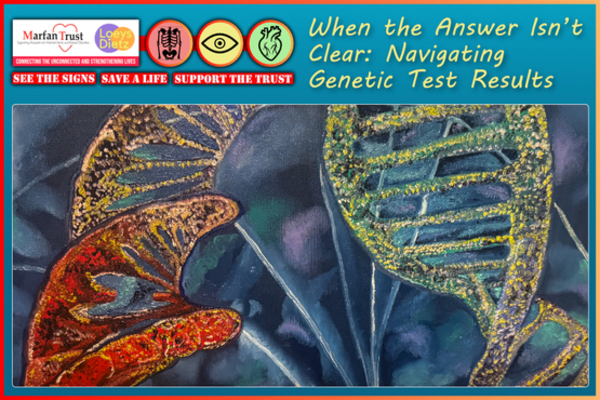
When The Answer Isn't Clear
Genetic Testing is not always conclusive
In the UK, if you are referred for genetic testing due to a suspected connective tissue disorder or a history of aortic dilatation or dissection, your blood will usually be tested for over 60 different genes which are now known to cause thoracic aortic aneurysm and dissection, these include the gene changes that cause Marfan syndrome and Loeys Dietz syndrome.
There are usually three possible outcomes when you are referred for genetic testing: a positive result, a negative result, or a variant of uncertain significance (VUS). The results require careful interpretation by your Geneticist. What do these outcomes mean?
A positive result means a gene change or variation known to cause a genetic condition has been found in your test results. The genetic results, along with your signs and symptoms, can be used to confirm a diagnosis. The positive result can be used to carry out ‘cascade testing’ on family members. Once a specific gene change has been found in you, family members can be screened for this gene change to see if they have the same condition. But what if the result is negative?
Negative Result
A negative result means that no changes were found in the genes that were tested. This does not completely rule out a genetic condition. There may be genes that weren’t tested or there may be genetic causes for your condition that have not yet been discovered. In these cases, your genetics team and doctors will decide carefully what ongoing care you need. If you have features of a condition, like a dilated aorta, you will still require ongoing surveillance and monitoring despite a negative result. As more genes are discovered, it may be that you are referred for further testing.
Variant of Uncertain Significance (VUS)
Sometimes a gene change is found, but it is not clear if it is linked to your condition. It cannot be used to make a diagnosis or prompt cascade testing for family members. Like a negative result, your geneticist will consider your risk and plan for ongoing surveillance and monitoring. Again, as discoveries in genetics continue, the significance of a VUS can change, and it may be added to the list of disease-causing genes.
The FBN1 gene now has its own rulebook. In 2024, the ClinGen FBN1 Expert Panel refined the rules for interpreting variants, adapting 14 of the 28 criteria developed by the American College of Medical Genetics and Genomics (ACMG) and the Association for Molecular Pathology (AMP) specifically for FBN1. The more difficult cases, including variants of uncertain significance (VUS), should be revisited after around three years. A genetic report is not dated but dynamic: what is uncertain today may be understood tomorrow
Ultimately, even if you receive a negative result or a VUS, you may still require ongoing monitoring and further testing may be recommended by your geneticist in the future.