Rarity must not diminish recognition. Whilst Loeys–Dietz syndrome may be a relatively recent addition to an already rare family of connective tissue disorders, it should be far better known and more readily diagnosed. Twenty-one years on from its identification, here’s all you need to know.

Loeys-Dietz (LDS) was first described in 2005 by Drs Bart Loeys and Harry Dietz. Prior to its identification, many patients with this condition were thought to have Marfan syndrome.
What is Loeys-Dietz Syndrome?
Loeys-Dietz is caused by a variant in one of the genes in the transforming growth factor-beta signalling pathway, TGF-β.
TGF-β is a cell-signalling system that helps regulate growth, inflammation, wound healing, and the formation of connective tissue. It is a key player in development and tissue repair.
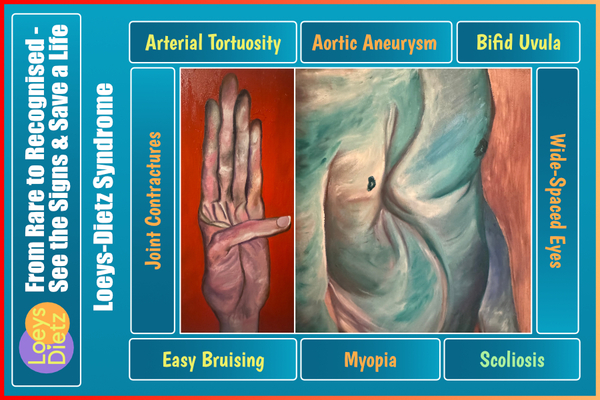
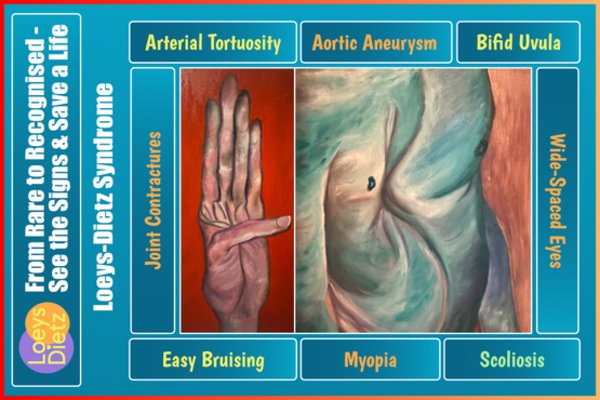
When a gene change occurs, it has implications for many systems of the body. Whilst symptoms vary from patient to patient, with some being similar to those of Marfan syndrome, the most defining characteristics are: arterial tortuosity, aortic enlargement, bifid uvula, curvature of the spine, high-arched palate and over-crowded teeth. The genes that cause LDS are: TGFβR1, TGFβR2, SMAD3, TGFβ3 and TGFβ2.
Signs & Symptoms
Connective tissue is found throughout the entire body, so LDS can affect many areas of the body.
LDS shares some similarities with other connective tissue disorders, such as Marfan Syndrome. These include: aortic dissection, scoliosis (spinal curvature), and deformities of the chest wall.
The following is not exhaustive but gives an idea of some of the signs & symptoms your medical team will be looking for:
• Aneurysms – an aneurysm is a widening or dilation of an artery. This is most often seen in the aortic root (where the aorta
meets the heart)
• Arterial tortuosity - twisting or spiralling arteries
• Hypertelorism-widely spaced eyes
• Bifid (split) or broad uvula- the uvula is the small piece of flesh that hangs down from the back of the mouth
How Does a Diagnosis Affect You?
Whilst LDS affects patients in different ways, and therefore management will be specific to you, there are some general management steps such as:
Monitoring of the aorta/blood vessels:
• Yearly echocardiograms (a scan of the heart)
• Regular CT/MRI angiograms of the head, neck, chest, abdomen, and pelvis to look
for aneurysms and dissections
Medication:
• Medicines to reduce stress on the heart, such as beta blockers and angiotensin
receptor blockers (ARBs)
Safe exercise:
• Gentle regular exercise such as walking, cycling, and swimming are beneficial for
patients with LDS
• Contact sports such as football and rugby should be avoided, as should strenuous
activity such as weightlifting or long-distance running
• Genetic testing might be recommended for other members of your family
• Pregnancy can pose additional risks and requires careful planning and specialist management