Pneumothorax
Sometimes it's the first clue ...

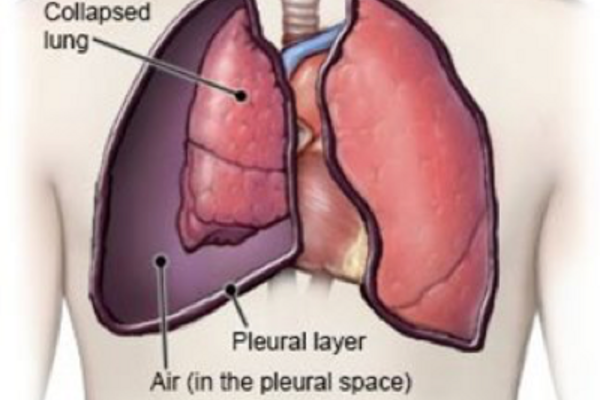
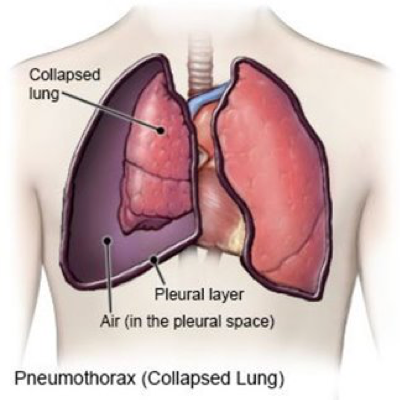
- Approximately 15% of people with spontaneous pneumothorax have a genetic cause and this could be a connective tissue disorder like Marfan syndrome (MFS) or Loeys Dietz
- 4-11% of people with MFS will suffer from spontaneous pneumothorax and it’s more common in young men
Symptoms
- Chest pain
- Pain that is worse when breathing in
- Cough
- Increased shortness of breath
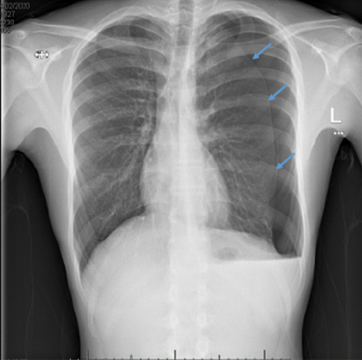
Diagnosis is made with a Chest X-ray (CXR) and treatment will be planned depending on the severity of the condition but could include oxygen, pain relief, chest drain.
This Chest X-ray with blue arrows shows the area of collapsed lung.
A small, simple spontaneous pneumothorax can sometimes be asymptomatic, meaning you may not feel anything at all. If symptoms do occur, the pain is typically sharp and stabbing in nature.
For a small pneumothorax, the air may dissolve of its own accord and require only observation in hospital, along with supplemental oxygen and rest. Although this does not require any treatment you should be given an appointment to return for follow up X-ray to check that it is resolving.
If intervention is needed, treatment options include:
Chest tube (chest drain) insertion: A tube is placed into the chest to remove air and allow the lung to re-expand.
Needle decompression: Excess air is removed via a needle inserted through the chest wall.
Surgical options: Sometimes preferred or necessary, particularly in recurrent cases:
Pleurodesis: A procedure that creates adhesion between the lung and chest wall to prevent further collapse. In Marfan syndrome (MFS), mechanical pleurodesis is generally preferred over chemical.
Bullectomy: Surgical removal of small air blisters (bullae) that are causing air leaks, often performed via thoracoscopy.