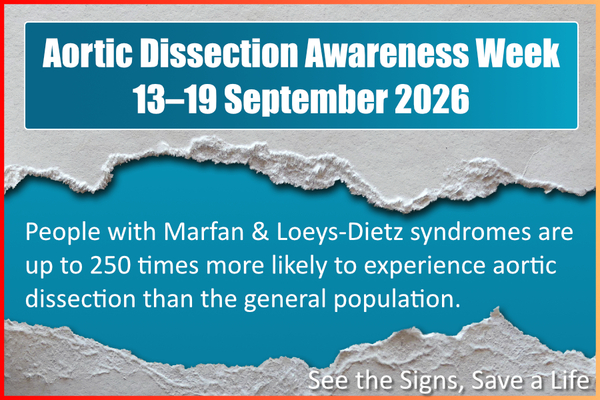
See the Signs, Save a Life. Aortic dissection is the most serious complication that people with Marfan or Loeys-Dietz syndromes can face. Missed diagnosis still costs lives. We are highlighting vital information everyone should know.
People with Marfan and Loeys-Dietz syndromes are up to 250 times more likely to experience aortic dissection than the general population. Aortic dissection is the most serious complication that people with Marfan or Loeys-Dietz syndromes can suffer. Missed diagnosis still costs lives.
Work to raise awareness is always going on here at the Marfan Trust and other charities are working tirelessly at this too. Awareness is needed amongst the general public as well as in health professionals, to recognise the signs, so that they ‘Think Aorta’ and get the right test at the right time.
Symptoms
Pain (chest, neck, back, abdomen)
Numbness in limbs
Collapse
Type of pain
Very sudden onset
Can come and go
Pain can be described as ripping or tearing
Risk Factors
* Connective tissue disorders (like Marfan syndrome, Loeys-Dietz syndrome)
* Family history of aortic dissection
* Known aortic aneurysm
* High blood pressure
Carrying an alert card is one way to ensure your heightened risk of aortic dissection is evident to health professionals. You can also include medical alert information on your smartphone.
What To Do if You Suspect an Aortic Dissection?
Aortic dissection requires urgent treatment. If you experience symptoms that could indicate a dissection, seek emergency medical help immediately and call 999. Carrying an alert card is one way to ensure your heightened risk of aortic dissection is evident to health professionals. You can also include medical alert information on your smartphone.
Chest pain has many possible causes, and aortic dissection may not be the first diagnosis considered, particularly if Marfan syndrome or a related condition is not already known.
If you have Marfan syndrome, Loeys-Dietz syndrome or another condition associated with aortic disease, tell the emergency department as soon as you arrive. Make sure the medical team knows your diagnosis and any relevant history, particularly previous problems with your aorta. This information may help them consider dissection promptly and arrange the appropriate investigations.
Why is the Aorta Vulnerable in Marfan and Loeys-Dietz Syndromes?
Marfan and Loeys-Dietz syndromes are characterised by a lack of connective tissue elasticity and this can compromise the wall of the aorta, causing it to dilate, bulge and tear (dissect).
Our body’s largest artery, the aorta arises directly from the heart’s left ventricle and all blood pumped from the heart must first pass into this artery. After leaving the heart, the aorta branches into large vessels that carry oxygen-rich blood to the entire body. A valve, the aortic valve, lies between the left ventricle and the aorta and functions to keep blood, once pumped out to the aorta from leaking back to the heart.
The wall of the aorta consists of three parts:
1) A thin, inner layer (intima) is the ‘tube’ through which the blood passes. It contains smooth muscle tissue, connective tissue and endothelial cells. These special cells enable blood to transport oxygen and nutrients without getting absorbed until it reaches the right spot.
2) A thick, elastic middle layer (media). This layer is made of smooth muscle tissue, elastin and collagen (proteins). These substances enable the aorta to meet your body’s changing blood flow needs. When more blood is necessary, the aorta widens. If less blood is needed, it narrows.
3) An outer layer (adventitia). The outer layer anchors the aorta in place. It also connects to nearby nerves and tissue.
In Marfan and Loeys-Dietz syndromes, the middle layer, the media is weaker than normal. Year after year, as the aortic wall faces the constantly changing stress generated by the beating heart, the wall, particularly in the aortic root which is the first two or four inches above the aortic valve (sinuses of Valsalva) can gradually stretch. In this region, the diameter of the aorta, usually about one and a half inches (3.7cm) in an adult, widens (dilates). This dilated region is known as an aortic aneurysm. When the enlargement reaches 4.5cm, surgery is considered. If untreated, and the aortic root is left to widen, it may develop a tear – dissection - in the wall. This tear may proceed downward through the middle layer of the aorta through which blood rushes causing the inner layer to also tear which constitutes a dissection. This is the most serious complication someone with Marfan syndrome can suffer. It is a time-critical medical emergency that when diagnosed and treated quickly has a better than 80% survival rate.
The beginning portion of the aorta – the root - dilates to some degree in nearly everyone with Marfan syndrome. The echocardiogram is the simplest method for detecting and measuring the aorta in this region. This enlargement usually begins quite early in life and is detectable using echocardiography in most infants with the condition. It can be managed medically with beta-blockers and angiotensin receptor blockers if or until elective surgery is required.