Edith Sitwell
A singular poet with Marfan syndrome

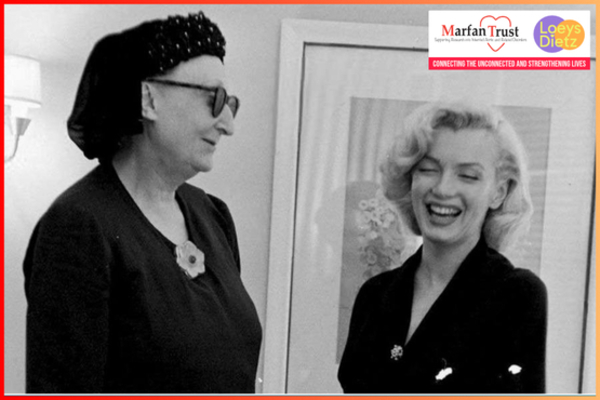
Edith Sitwell (1887–1964) was born to Sir George Sitwell and his wife, Lady Ida Denison in 1887. Her aristocratic parents lived in the family home in Derbyshire, Renishaw and their fortune came from land and ironmaking.
Her early years were marked by both physical constraint and emotional distance. Tall, awkward, and physically fragile, she endured long periods in restrictive braces, imposed by parents who seemed more concerned with correction than comfort.
Yet her precocious intellect revealed itself early. At just four years old, she declared, without hesitation, that she intended to become a genius. It was a childhood she would remember with bitterness; her relationship with her mother never recovered, and in adulthood she chose not to attend her funeral.
She found greater warmth in her relationship with her brothers, Osbert and Sacheverell, who went on to establish literary reputations of their own. Equally important was Helen Rootham, her governess and later companion, a poet whose presence remained constant as they lived together in London and Paris.
Edith Sitwell is celebrated for her experimental, highly rhythmic verse and her flamboyant public persona. Her early work, particularly Façade (1922), emphasised sound and “verbal music,” using playful rhythms and abstract imagery, though it initially divided critics.
During the Second World War, her poetry took on a deeper emotional and spiritual intensity, as seen in works like Still Falls the Rain, reflecting on suffering, faith, and the devastation of war.
Across her career, she explored themes such as love, mortality, and social injustice, combining rich symbolism with a distinctive, often haunting musicality'
Her fame was unmistakable when she and her brother Osbert toured the United States in 1950. In Hollywood, she was welcomed with excitement by stars like Charlie Chaplin, Greta Garbo, Merle Oberon, and Marilyn Monroe. While respected for her poetry, it was impossible to ignore her theatrical presence: tall and commanding, with a sharp aquiline nose, she dressed in sweeping robes, a turban-style headdress, and bold, oversized rings.
Her striking physical presence owed much to Marfan syndrome. Shortly after her return from Hollywood, she became reliant on a wheelchair. Yet her literary output remained undiminished, and in 1954 she was honoured with a damehood. She died in 1964 at the age of 77.


